The Pros and Cons of ETF Investing for Beginners
When I started investing, ETFs barely existed. You wanted diversification? You bought mutual funds and paid through the nose, or you picked stocks one at a time and hoped you didn't blow up.
Now beginners can buy the entire S&P 500 for 0.03% a year.
That's incredible. It's also not the whole story.
The Good Stuff
Instant diversification without a PhD
One ETF can hold hundreds of stocks. You're not betting on a single company surviving—you're betting on the market.
For beginners who don't have time to read 10-Ks and stress-test balance sheets, this is genuinely useful. You get broad exposure while you learn.
ETFs let you be approximately right instead of precisely wrong.
Costs that actually matter
Many ETFs charge less than 0.10% annually. Some charge 0.03%. That sounds like nothing until you do the math over 30 years.
A 1% fee vs. a 0.05% fee on $100,000 growing at 8% annually?
- 1% fee: $574,000 after 30 years
- 0.05% fee: $936,000 after 30 years
That's $362,000 eaten by fees. Not returns. Fees.
Costs compound just like returns. Except in the wrong direction.
You can actually get out
ETFs trade all day like stocks. Mutual funds? You put in an order and wait until market close to find out what price you got.
When the market is falling apart, I want to know what I'm selling for. Not guess.
The Not-So-Good Stuff
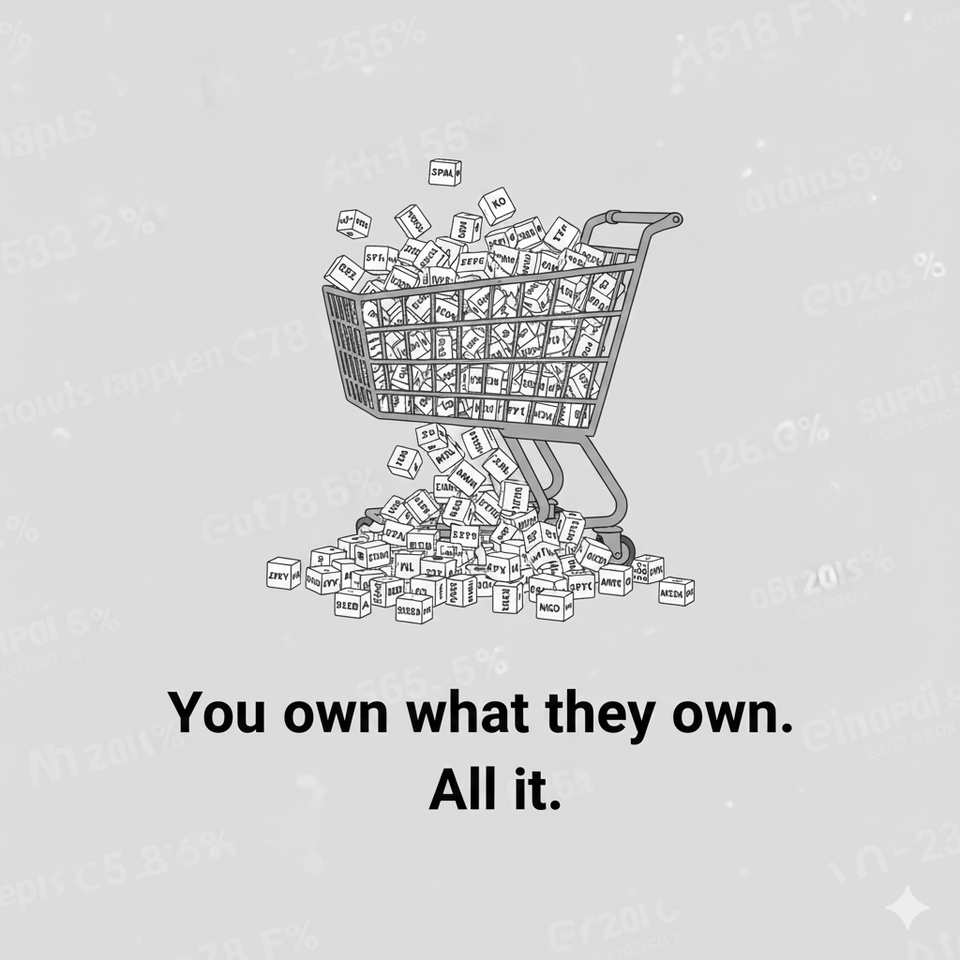
You own what they own
Buy an ETF, you inherit the whole basket. Every winner. Every loser. Every company you'd never touch with a ten-foot pole if you'd actually looked at it.
Thematic ETFs are the worst offenders. "Clean Energy ETF" sounds great until you realize half the holdings are bleeding cash and praying for subsidies.
With ETFs, you don't pick the ingredients. You just eat the soup.
Niche ETFs can trap you
Big ETFs like SPY or VTI? Liquid. You can sell a million dollars worth and barely move the price.
That obscure frontier-market ETF with $50 million in assets? Good luck. The bid-ask spread alone might cost you 1-2% on the way in and out.
I learned this the hard way once. Never again.
Dividends get messy
When you own individual stocks, you can set up automatic reinvestment. Clean. Simple.
ETF dividends? They often just land in your account as cash. Now you have to manually reinvest them or watch them sit there earning nothing.
It's not a dealbreaker. It's just friction most beginners don't expect.
Tracking error is real
Index ETFs are supposed to match their benchmark. They don't. Not perfectly.
Management fees, sampling strategies, timing issues—it all adds up. Over 20 years, a 0.2% annual tracking error compounds into real money you'll never see.
The Dividend Problem
Here's what bugs me most about dividend ETFs.
They own everything that pays a dividend. No quality filter. No payout ratio check. No "will this company still exist in 10 years" test.
You end up owning yield traps alongside legitimate compounders, and you can't tell which is which without digging into the holdings.
High yield isn't the same as high quality. ETFs don't know the difference.
If you're serious about dividend income, you eventually need to own individual names—companies with decades of dividend growth, sustainable payout ratios, and actual moats.
Names like:
- Colgate-Palmolive (CL) — 62 consecutive years, defensive consumer staples, global reach
- Procter & Gamble (PG) — 69 years
- Coca-Cola (KO) — 63 years
- Walmart (WMT) — 52 years
- McDonald's (MCD) — 49 years
These aren't exciting. They're not going to 10x. But they pay you while you sleep and they've done it through recessions, crashes, and pandemics.
No ETF replicates that track record perfectly. They approximate it.
The Bottom Line
ETFs are a tool. A good one. Especially for beginners.
But they're not a replacement for thinking.
ETFs give you exposure. Individual stocks give you ownership. Know the difference.
Use ETFs for your core. Use them when you don't have time to research. Use them for asset classes you don't understand well enough to pick winners.
But if your goal is income that grows every year, from businesses you actually understand?
Eventually, you'll want to own the stocks yourself.
Disclaimer: This is for educational purposes only. I'm not a financial advisor. Do your own homework.
Member discussion