
Understanding the Impact of Inflation on Dividend Investments
Inflation is the silent tax that never asks permission. It doesn’t care about your “income plan,” your yield, or your favorite Dividend King. It just eats purchasing power, year after year.
If your dividends don’t grow faster than inflation, you’re getting poorer in slow motion—no matter how “safe” the payout looks.
For DIY investors who live in the world of Dividend Kings, Aristocrats, and blue-chip income names, the job is simple to say and hard to do:
Own companies whose real dividend growth and free cash flow outrun inflation.
The tickers below aren’t stock tips. They’re sector examples of how inflation interacts with different business models.
Johnson & Johnson (JNJ): Resilient… With Hair
Healthcare is one of the cleanest places to fight inflation. Demand is less cyclical, pricing is sticky, and cost cuts don’t instantly kill the franchise.
JNJ has:
- ~63 years of dividend hikes.
- EPS payout around the mid-50s%.
- A long history of outpacing inflation with dividend growth.
On paper, that’s textbook: solid balance sheet, disciplined payout, real pricing power.
But you don’t get to forget the lawsuits and headline risk. Inflation doesn’t cancel legal overhangs. Result: JNJ is a case study in a fundamentally strong inflation fighter with non-trivial tail risks. The framework says “good”; the real world adds “handle with care.”
Procter & Gamble (PG): Inflation Pass-Through Machine
Consumer staples are built for inflationary times—if they have brands people refuse to trade down from.
PG:
- ~69 years of dividend growth.
- EPS payout ~60%.
- FCF payout comfortably under 80%.
Input costs spike, they raise prices, units wobble a bit, and a year or two later the dividend is higher and margins normalized. That’s what scale, brand, and distribution buy you.
PG is what you actually want in an inflation fight: predictable, incremental dividend growth that roughly tracks or slightly beats inflation without stretching the balance sheet.
Coca-Cola (KO): Still a Brand Fortress, But Near the Edge
KO lives where inflation, volume, and payout math collide.
You’ve got:
- ~63 years of dividend increases.
- EPS payout near 70%.
- FCF payout flirting with, but not blasting through, the 80% “comfort” line.
KO can push price/mix to offset inflation—but volumes and growth have been wobbling. That’s fine… until it isn’t. At a ~70% EPS payout, there isn’t much room for error if margins compress or volume weakens more than expected.
In an inflation framework, KO is borderline but viable: still a brand powerhouse, still funding the dividend, but not a place to be asleep at the wheel. You watch coverage and volume like a hawk.
Walmart (WMT): Low Yield, Quiet Inflation Hedge
Walmart isn’t going to impress anyone on headline yield, but that’s not the point.
Roughly:
- 52 years of consecutive dividend increases.
- EPS payout in the mid-30s%.
- 5-year dividend growth in the 4–5% range.
That’s slightly ahead of normal inflation and backed by a model that benefits when consumers trade down. Scale and supply-chain leverage let WMT manage costs and pass along price increases without blowing up demand.
In plain terms: Walmart is a stealth inflation hedge wrapped in a boring dividend.
Realty Income (O): When Inflation Meets Real Assets
REITs behave differently in inflation.
Realty Income:
- ~30 years of dividend hikes.
- AFFO payout in the mid-70s%.
- Monthly dividends, with leases that often carry rent escalators.
Rents tend to reset higher over time, and replacement costs rise, which supports both NAV and long-term cash flow. That’s the good news.
The catch:
- Payouts are generally taxed as ordinary income, not qualified dividends.
- Rising rates and inflation can pressure REIT multiples even while nominal cash flow is OK.
So O fits the “inflation-aware income” bucket, but with a clear caveat: solid fundamental hedge, mediocre tax profile.
Where This Breaks: When Payouts Ignore Reality
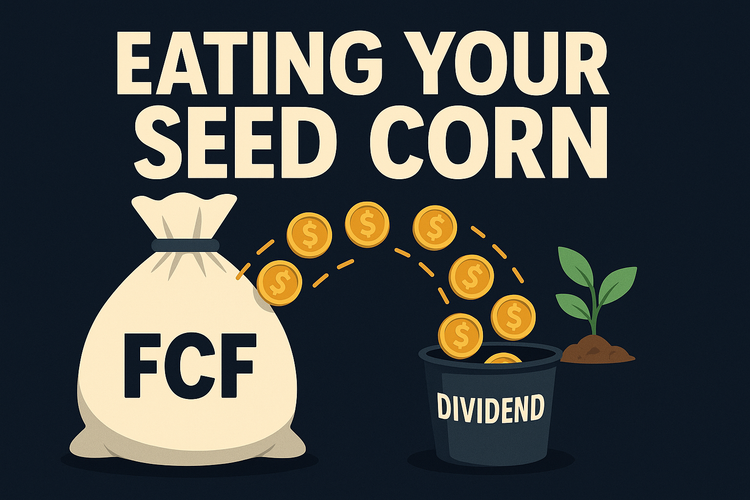
High yield and a long streak don’t mean a thing if the coverage is broken.
The red flags in an inflationary world:
- EPS payout consistently above ~80% and drifting higher.
- FCF payout pushing past ~90% without a clear, temporary reason (one-off capex, reset year, etc.).
- Dividend growth outrunning earnings and free cash flow for several years in a row.
That’s how you end up with names that look like quality dividend plays but are really just future cuts waiting for a recession or a prolonged inflation shock.
The point isn’t to blacklist every company with a high payout in a single year. It’s to avoid businesses where both the payout ratio and the cash coverage are stretched and there’s no room for inflation, a downturn, or a bad cycle.
Yield Lies. Total Return Doesn’t.
One thing you don’t need to repeat five times: the ex-dividend price adjust.
Advanced version:
- On the ex-date, the stock price typically drops by roughly the dividend amount.
- There is no free lunch in “dividend capture.”
- Your real gain is:
- Price change
- Dividends received
– Inflation
– Taxes
That’s it. Yield alone is marketing. Inflation-adjusted total return is what pays the bills in retirement.
Playbook for DIY Dividend Investors
If you take nothing else from this:
- Favor dividend growth over raw yield.
If the dividend isn’t growing at least in line with inflation, you’re going backward. - Watch payout ratios like a risk meter.
- EPS payout ≤70% (≤60% in healthcare)
- FCF payout ≤80%
Above that, demand a very clear, temporary reason—or pass.
- Focus on business models with pricing power.
Staples (PG), select healthcare (JNJ with caveats), scale retailers (WMT), and real-asset plays (O) can push prices through without losing the franchise. - Think in after-tax, real terms.
Ordinary-income REIT dividends vs qualified dividends matters. If you’re in a high bracket, asset location (tax-advantaged vs taxable) is part of the strategy. - Ignore ex-div noise. Track 5–10 years.
Check whether:- Earnings per share grew.
- Free cash flow per share grew.
- The dividend grew faster than inflation.
- The payout ratio stayed sane.
If those boxes are checked, inflation becomes an input, not a fatal flaw.
The Inflation Reality
Inflation is not a reason to abandon dividend investing. It’s a reason to raise your standards.
- Pick businesses that can raise prices.
- Demand dividend growth backed by earnings and cash flow, not hope.
- Avoid stretched payouts, even if the name is “famous” or has a perfect streak.
Hold long term, reinvest where it makes sense, and let real dividend growth plus capital appreciation do the heavy lifting.
Standard Disclaimer
This information is for educational purposes only and does not constitute investment advice. Always perform your own due diligence or consult a professional advisor before investing. Past performance is not indicative of future results.


Member discussion