
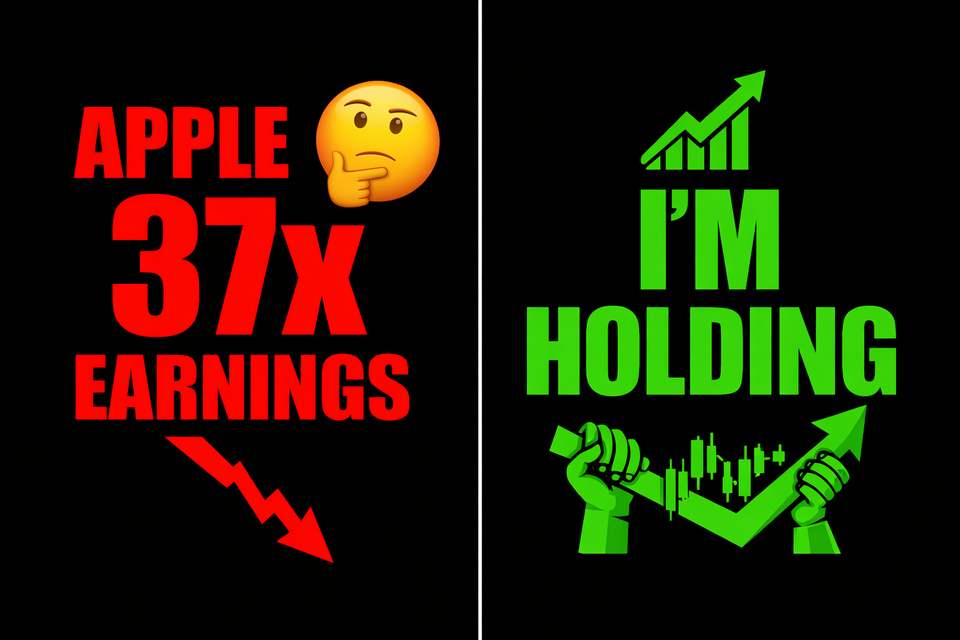
Is Apple Worth 37x Earnings? My Unpopular Answer
From Day-Trading Degenerate to Never Checking Prices: The Only Process That Survived Everything
For 35 years I never once checked a stock price on a random Tuesday.
I asked three questions:
Should I keep it?
Should I replace it?
Should I own it at all?
That was the entire process. A stock either belonged in my portfolio or it didn’t. The market’s opinion was noise.
This survived dot-com, 2008, COVID, and everything since.
Four months of writing publicly almost destroyed it.
I didn’t always think this way. I’ve day traded, swing traded, traded options, tried forex. I’ve checked prices twelve times a day and convinced myself the adrenaline was alpha.
It wasn’t. Not for me.
What I learned over time was that I was better at a different game. Not timing entries and exits—but deciding what belonged and what didn’t. Owning businesses, not renting tickers.
Once that clicked, I stopped fighting my temperament and started playing the game I could actually win.
What Writing Changed
Four months ago I launched Phaetrix Investing. Fundamentals first. Math over hype. No fairy tales.
What I didn’t expect was how much publishing would change my process.
When you’re investing for yourself, you can hold a thesis loosely. You know why you own something. You don’t need to explain it.
When you’re writing for 200 people, you have to make the thesis explicit. You have to show the math. You have to say, out loud, “here’s what breaks this.”
That discipline was useful. But it also introduced something I’d spent decades ignoring: the question of what the market is currently pricing in.
The Trap
Market analysis is seductive. You can point to multiples, implied growth rates, sentiment indicators. You can build frameworks that explain why a stock is “expensive” or “cheap.”
When I wrote about Apple at 37x on 6% growth, I wasn’t wrong to ask why. The answer—passive flows, buybacks, the Google annuity, a multiple that never came back down—was worth understanding.
But here’s the trap: you can get so caught up in explaining what the market thinks that you forget to ask what you think.
I own Apple. It’s about 35% of my portfolio.
And I just wrote a piece explaining why it looks expensive.
That’s not a contradiction. That’s the whole point.
The question isn’t “is Apple expensive today?” The question is “does Apple still belong in my portfolio?”
Different question. Different answer.
I bought Apple years ago at a much lower price. The business has compounded. The thesis hasn’t broken. Selling because the multiple looks stretched means paying taxes, reinvesting somewhere else, and hoping I’m right about timing.
I’m not good at timing. I know this about myself.
So I hold. Not because 37x is cheap. Because selling a compounder to buy something else is usually a mistake—and I’ve made that mistake enough times to stop making it.
What the Market Asks vs. What I Ask
Market: Is 37× cheap?
Me: Does it still belong? Yes.
Market: Beat next quarter?
Me: Moat intact? Yes.
Market: What’s priced in?
Me: What would force a sell? See below.
KILL SWITCH — APPLE
Starting in 2026, every stock write-up ends with a Kill Switch—the only conditions under which I sell. No negotiation. No hope. No “one more quarter.”
Services growth under 5% for four consecutive quarters
China revenue down more than 30% year-over-year with no recovery in 12 months
Capex exceeds 25% of operating cash flow for two years running
Succession risk turns real—Cook leaves with no credible internal replacement
If none of those happen, I hold at 50x or 15x. Doesn’t matter.
What I Got Wrong
I got Caterpillar wrong.
I said the quarter looked soft. The stock ripped 9%. I re-ran the numbers. The valuation problem got worse—but the market didn’t care.
Being right about the business and being right about the stock are two different things. I was analyzing fundamentals. The market was trading flows and sentiment.
That’s fine. I don’t need to be right about the next quarter. I need to be right about the next decade.
But writing forces you to timestamp your calls. When you’re wrong in public, you either own it or lose credibility. I owned it. Wrote a whole piece about it.
That’s the trade-off. You can’t hide. But if you’re honest about the misses, the hits mean more.
What I Got Right
The contrarian stuff worked.
When everyone was breathless about NVIDIA, I asked what happens when your four biggest customers build their own silicon. When Tesla was trading on robotaxi dreams, I focused on the auto business underneath. When Palantir was a momentum darling, I ran the numbers on what the multiple implied.
These pieces traveled. They got restacked. They sparked arguments.
But I wasn’t trying to be contrarian. I was just asking the questions I’d always asked. What’s the business worth? What breaks the thesis? What am I paying for?
What Stays the Same
After all of this—the writing, the framework evolution, the public accountability—my core process hasn’t changed.
- Should I keep it?
- Should I replace it?
- Should I own it at all?
I still own businesses, not tickers. I still plan to hold for years, not quarters. I still don’t care what the market thinks on any given Tuesday.
What’s changed is that now I write it down. I show my work. I let strangers poke holes in my logic.
That’s made me a better investor. Not because I’m smarter. Because I can’t hide from my own reasoning anymore.
What’s Next
In 2026, every analysis gets a Kill Switch. Every piece includes “What Would Change My Mind.” Every thesis gets stress-tested against the bear case before I publish.
I’m also going to keep being wrong in public. Caterpillar won’t be the last miss. But every mistake that gets documented is a mistake I’m less likely to repeat.
If you’ve been reading since the early days, thank you. You took a chance on something that didn’t exist yet.
If you’re new, here’s the deal: I don’t sell fairy tales. You’ll get the risks as clearly as the upside.
That’s the only promise I can keep.
So tell me—brutally—
What are your three questions?
Or do you still think you’re smarter than the market at its own game?
Disclaimer:
I'm not a financial advisor and this isn't financial advice. I'm sharing my analysis and opinions for educational purposes. Do your own research and consult a professional before making investment decisions.



Member discussion