
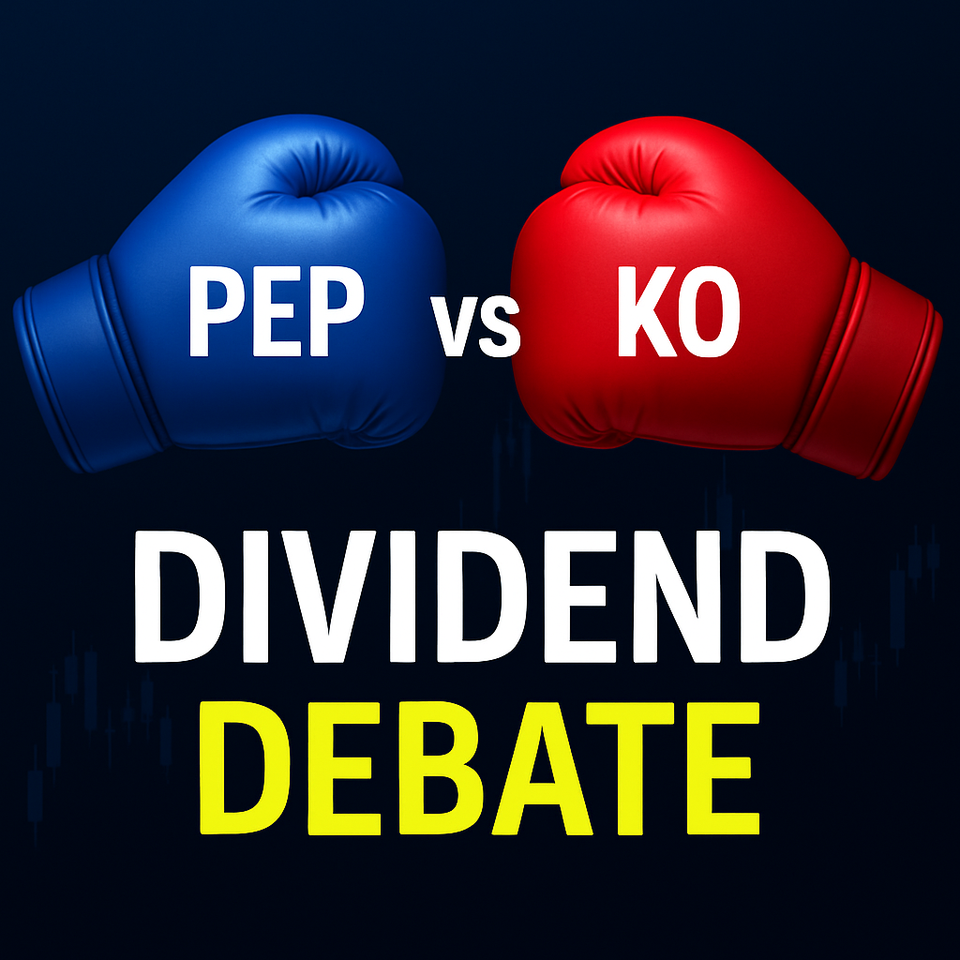
PepsiCo vs Coca-Cola: The Dividend Debate That Won’t Die
Grab the last of the coffee—I’m settling this one today.
The Short Version
PEP is the better business at the better price—but still not in my buy zone. KO is a premium-priced soda pure play riding a single sub-brand. At today’s levels, I prefer patience over both.
What You’re Actually Buying
Coca-Cola is a soda company. Water, sports drinks, juice, coffee, tea—sure. But strip away the marketing and it’s still a sugar-water empire in a world that’s increasingly scared of sugar. The brand is untouchable. The business model is a one-trick pony in a very nice tuxedo.
PepsiCo is a snack company that happens to sell beverages. Frito-Lay alone generates more operating profit than most S&P 500 companies. Doritos, Cheetos, Lay’s, Tostitos—these aren’t side businesses. They’re the engine. The drinks are the diversification play.
That distinction matters. A lot.
Dividend & Cash Flow: The Numbers That Actually Matter
Since you’re probably here for the income angle, let’s put these side by side.
Coca-Cola (KO)
- Dividend yield: about 2.9%
- Annual dividend: $2.04 per share
- Consecutive dividend increases: 63 years
- Payout ratio: roughly 70%
- Free cash flow (2025 guidance): around $9.8 billion
- FCF yield: roughly 3.3%
- Net debt to EBITDA: about 1.8x
PepsiCo (PEP)
- Dividend yield: about 3.5%
- Annual dividend: $5.42 per share
- Consecutive dividend increases: 52 years
- Payout ratio: roughly 75%
- Free cash flow (2025 guidance): a bit over $8 billion
- FCF yield: roughly 3.5%
- Net debt to EBITDA: about 2.5x
What this tells you:
PEP pays more today—around 60 basis points of extra yield, compounding over a decade. That adds up.
KO’s payout ratio is slightly lower, which theoretically means more room to grow the dividend. In practice, both are mature payers grinding out low-single-digit hikes. The difference is marginal.
KO’s balance sheet is cleaner, but PEP’s diversification gives it more ways to defend the dividend if one segment stumbles.
The income question: Which cash stream would I rather rely on for the next 10–20 years? PEP’s—because snacks provide a buffer beverages don’t.
Growth: Both Are Hiking Price to Hide Demand Fatigue
Let’s not pretend either of these is a growth story.
Coca-Cola Q3 2025: about 6% organic revenue growth, 1% unit case volume growth. Coke Zero (around +14% volume) is doing most of the work. Everything else is basically flat.
PepsiCo Q3 2025: about 4% organic revenue growth, with Frito-Lay North America volume down roughly 1.5% and beverage volume down roughly 3%. Snacks are under pressure, but Frito-Lay is still throwing off operating margins around 28% or better.
The punchline: both are jacking prices and hoping consumers keep paying. That’s not growth—it’s a pricing experiment with an expiration date.
KO’s entire growth story rides one sub-brand. PEP’s volume is negative, but Frito-Lay’s margins provide cushion. One company has a backup plan. The other doesn’t.
Neither is compounding volume. You’re buying cash engines, not growth stocks—treat them that way.
The Moat
Both are A-tier. But the deciding factor isn’t moat depth—it’s price sustainability and diversification.
KO’s global bottler network is simply harder to recreate. They can put a Coke in the hand of someone in a village with no running water. That’s fortress-level infrastructure.
PEP’s moat is shelf space. Frito-Lay doesn’t just compete in the salty snack aisle—it owns the aisle. Direct-store-delivery means they control placement, freshness, and retailer relationships.
Bottom line: both moats are strong. Neither is under serious threat. This isn’t where the decision gets made.
Valuation: The Gap Nobody Talks About
Coca-Cola: roughly 22 times forward earnings at around $70.50 per share.
PepsiCo: roughly 18 times forward earnings at around $153 per share.
You’re paying a 20%+ premium for KO’s earnings. For what, exactly? Slightly better volume (plus one percent instead of negative)? Eleven extra years of dividend streak?
At about 22 times earnings, you’re pricing in near-perfection. Every quarter needs to come in clean. Zero-sugar needs to keep scaling. FX needs to cooperate. SNAP restrictions can’t spread. No more recall headlines.
PEP at about 18 times earnings has more room for error. Frito-Lay can stumble for another quarter and the stock doesn’t crater—because you’re not paying for perfection.
The dividend crowd is paying a premium for KO’s story while PEP’s math is better.
What Breaks Each Thesis
For KO, I’d start worrying if:
- Volume flips negative for three consecutive quarters.
- SNAP soda restrictions spread beyond the pilot states.
- Coke Zero growth stalls.
- Operating margins crack below 30%.
Any of these and that roughly 22x multiple can compress fast.
For PEP, I’d start worrying if:
- Frito-Lay volumes stay negative for four or more quarters.
- Beverage market share losses accelerate.
- Management reaches for a big M&A deal instead of fixing the core business.
- Operating margins compress below 12%.
Both have real risks. KO’s are more existential—when soda stumbles, there’s nowhere to hide.
The Verdict
PepsiCo is the one I want to own.
Not because it’s cheap—it’s not. Not because the growth is exciting—it isn’t. But because:
- Frito-Lay is the better business. Snacks have more volume resilience than soda.
- Diversification isn’t a buzzword here. When beverages struggle, snacks carry.
- The valuation gap is real. About 18x vs about 22x for similar growth? I’ll take the discount.
- Higher yield today. Roughly 3.5% vs roughly 2.9% matters over a decade.
I just don’t want it at this price.
Where I’d Get Interested
For me, both names only start to look interesting after roughly a 7–10% pullback from here.
PepsiCo (PEP)
- Current price: around $153 (mid-November)
- My watchlist range: $140–145
- Why: that’s the range where I’d consider adding if the story still holds
Coca-Cola (KO)
- Current price: around $70.50 (mid-November)
- My watchlist range: $65–68
- Why: that’s where the yield and the multiple start to line up better for me
The Playbook (What I’d Do)
If I owned KO today:
I’d keep it for the income and the moat, but I wouldn’t add around $70.50. I’d only get interested in adding if it drifted into the mid-to-high $60s, where the yield and multiple actually line up with the risk for me.
If I owned PEP today:
I’d hold and let the dividend work, but I wouldn’t be buying more at roughly $153. My add zone is in the $140–145 area. Above that, I’m happy to collect the checks and wait.
If I owned neither and wanted dividend exposure:
I’d put PEP on a watchlist with alerts around $145 and keep KO on my radar closer to the high $60s. If the prices never come to me, so be it. There’s no rule that says I have to own either name.
If I were running a growth-tilted portfolio:
I wouldn’t own either at these levels. I treat KO and PEP as cash engines and bond proxies with equity volatility—not growth names.
Final Take
At the right price, I’ll take PEP over KO every time.
At today’s prices, I’ll take cash and patience over both.
Quality at fair beats perfection at premium.
If you want analysis that cuts through the noise—fundamentals first, hype last—subscribe to Phaetrix Investing.
Everything here is how I’m thinking about KO and PEP for my own portfolio.
Disclaimer: This content is for informational and educational purposes only—not financial advice. Do your own due diligence before investing. Nothing here is a recommendation to buy or sell any security.

Member discussion