
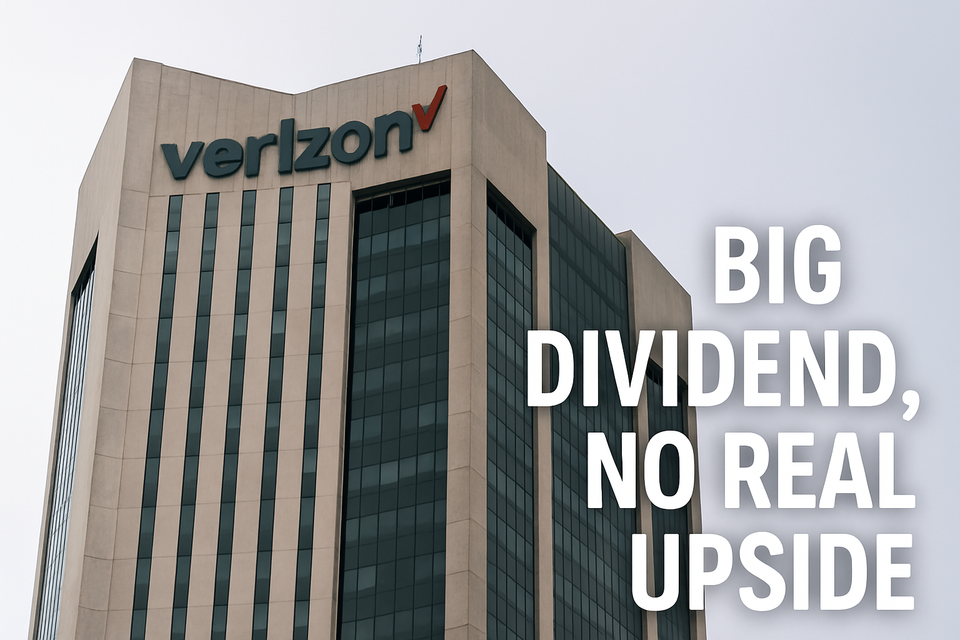
VERIZON (VZ): Junior telecom debt with a utility ceiling
For: dividend / income-focused investors
Horizon: 3–5 years — not a trade
Realization
Everyone’s arguing about whether Verizon can stop the wireless bleed.
The real question: what do you own if Schulman actually succeeds?
A bigger, more regulated fiber utility whose equity behaves like junior debt — a 6.7% coupon with a 10× P/E ceiling.
Core Thesis
VZ is junior unsecured telecom debt disguised as equity — and even the bull case (Frontier succeeds, wireless stabilizes, costs get cut) just locks you deeper into regulated utility status with no path to multiple expansion.
You’re earning 250–300bps over Treasuries for levered exposure to a business that’s trading volume for ARPA today and trading growth optionality for regulatory constraints tomorrow.
If I wouldn’t buy a BBB-rated 30-year Verizon bond at 6.7%, I have no business owning the equity at the same yield with more risk.
Business & Fundamentals (What the Company Is)
Verizon is the #2 U.S. wireless carrier by subs and a legacy wireline/fiber provider. Revenue is ~$135B annually, split roughly 70/30 wireless/wireline. Wireless is flat to slightly down; wireline (Fios fiber, fixed-wireless access) is growing but from a small base.
Recent operating reality — the “milking the base” story:
Q3 2025: postpaid phone churn was 0.91%, overall postpaid churn 1.12% — not blowing out, but VZ posted net postpaid phone losses of 7,000 subs vs +18,000 net adds a year ago. Meanwhile, wireless service ARPA rose ~2% YoY. Translation: they’re pushing price on a shrinking base to keep revenue flat. That works for 2–3 years to defend FCF and the dividend; long-term, it’s a run-off book strategy — squeeze existing customers, cut costs, don’t grow units.
T-Mobile added 850K+ postpaid phones in Q3. The competitive gap isn’t churn; it’s net growth. VZ isn’t retaining badly; they’re just not winning new subs.
Total broadband net adds were 306K in Q3 (261K FWA, 61K Fios internet). Wireline is real growth, but it’s 30% of revenue and can’t offset wireless erosion fast enough without the Frontier deal.
The Frontier bet: $20B acquisition closing in 2026 adds ~2.2M fiber customers and expands VZ’s fiber footprint to ~25M+ homes passed combined today, scaling toward 30M+ with 1M+ annual passings. Management’s pitch: bundling synergies with wireless, lower wireline churn, BEAD infrastructure tailwinds. On paper, this is the only credible multi-year growth story VZ has.
What they don’t say: Those same conditions come with tightening regulation and affordability mandates. California forced VZ to commit to $20/month broadband for low-income users for 10 years as a condition of approving the deal. The FCC tied approval to VZ ending its DEI programs and restructuring related HR functions. Translation: the more fiber scale VZ adds, the deeper it gets boxed in by political and regulatory constraints. You’re not buying optionality; you’re buying a bigger, fatter utility with a lower economic ceiling.
Gross margins mid-50s; operating margin low-20s — both under pressure from promotional spend and network costs. Free cash flow guidance for 2025 is $19.5–20.5B (up from historical $17–18B levels), covering the $11B dividend at ~55% payout. FCF per share has been flat for 3 years despite the recent uptick.
Balance sheet: $112B net debt (total unsecured debt $119.7B), roughly 2.2× net debt/EBITDA per company guidance. That’s still heavy for a no-growth, high-capex business, though they are slowly delevering from a high base (total debt was $126B a year ago). Capex guidance for 2025 is $17.5–18.5B — down from the ~$20B peak, but still brutal, and Frontier adds more fiber capex on top once it closes. Management has only guided to this mild step-down with no visibility below that band once Frontier is layered in.
Capital allocation: $2.76/share dividend (6.7% yield), minimal buybacks, $20B Frontier acquisition closing in 2026. Dividend payout is ~55% of current FCF guidance — safe unless FCF dips, but leaves little room for capex surprises. There is a theoretical deleveraging path (FCF minus dividend minus capex), but it fights directly with dividend protection and fiber capex. At best, it’s slow and fragile.
Valuation: 8.8× forward P/E, ~5× EV/EBITDA, FCF yield ~7.5%. That’s cheap vs the S&P (20× P/E) but in line with AT&T and below T-Mobile (which trades at a growth premium). Historically VZ traded 10–12× P/E when it was growing subs; today’s 8.8× reflects a no-growth, show-me-the-FCF story. The multiple isn’t depressed; it’s appropriate for a levered, no-growth, regulated quasi-utility. Even if Frontier works perfectly, the best you get is a re-rate to 10–11× — which is what regulated fiber utilities trade at. You’re not buying optionality; you’re locking in a ceiling.
Red Flags / What’s Changing
- Volume-for-ARPA trade is a short-term fix with long-term erosion: Net postpaid phone adds flipped negative (−7K in Q3 vs +18K a year ago) while ARPA rose 2% — classic milking-the-base playbook. That defends revenue and FCF for 2–3 years, but eventually you run out of base to squeeze.
- Frontier “success” = deeper regulatory capture, not growth optionality: Approval conditions include 10-year $20/month broadband mandates and policy restructuring. If Schulman executes perfectly on Frontier, you don’t own a growth story — you own a bigger, more politically constrained fiber utility whose economic upside is capped at 10–11× earnings. The better the integration goes, the tighter the regulatory straightjacket becomes.
- Capex step-down is minimal and uncertain: VZ guided capex down to $17.5–18.5B for 2025 from the ~$20B peak, but there’s no credible path below that band once Frontier adds fiber capex post-close. Even at the lower end, that’s still 13–14% of revenue — you’re stuck in a high-capex, low-growth trap.
- Execution risk under new CEO with a sledgehammer: Schulman is cutting 13,000 jobs (13% of workforce) to save $2–3B annually, but cost cuts don’t fix subscriber share losses. If wireless keeps bleeding, he’ll have cut costs into a smaller business — not turned it around.
- Legacy infrastructure liabilities: Lead-sheathed cable remediation lurking in wireline footprint; no pricing power in wireless (regulatory/political backlash if you raise consumer prices). This is a business with shrinking volume and no ability to raise prices — the worst possible mix.
- Slow deleveraging from a high base: At 2.2× net debt/EBITDA with $17.5–18.5B annual capex and 55% dividend payout on current FCF guidance, the theoretical deleveraging path (FCF minus dividend minus capex) is slow and fragile. Any FCF miss (recession, worse churn, Frontier cost overrun) tightens dividend coverage and crushes the equity.
Expectations vs Reality (Consensus Check)
- Street view: Consensus expects low-single-digit revenue growth (helped by Frontier close in 2026), flat EBITDA margins, and FCF sustained around $19–20B through 2027. Most bulls frame Frontier as growth upside: expanded fiber footprint to ~25M+ homes passed today scaling toward 30M+, 1M+ new passings per year, bundling synergies, lower churn, BEAD infrastructure tailwinds. The narrative is “Frontier unlocks the wireline growth story, offsets wireless weakness, and VZ re-rates from 8.8× to 10–11× P/E as a stable utility.” Bulls say “it’s cheap at 8.8× P/E with a safe 6.7% yield.”
- My view: Even the bull case locks you into utility status — you don’t escape it. Consensus treats Frontier as an upside lever; I’m treating it as a regulatory trap that caps your upside even if execution is flawless. If Schulman succeeds — wireless stabilizes, Frontier integrates cleanly, fiber grows at 1M passings/year — you don’t suddenly own “fiber growth”; you own a bigger, more regulated wireline/wireless bundle whose economic ceiling still looks like 10–11× earnings. California is already forcing $20/month low-income broadband for 10 years; the FCC tied approval to policy changes that deepen political oversight. The more fiber scale VZ adds, the tighter the regulatory constraints become.
Meanwhile, the 10-year Treasury yields ~4.1% today; IG corporate credit yields ~5–5.5% depending on duration. VZ’s equity yields 6.7%. You’re earning 250–300bps of risk premium over Treasuries and 150–200bps over IG credit for:
- A shrinking core product (postpaid phones going negative)
- 2.2× leverage with a slow, fragile deleveraging path
- $17.5–18.5B annual capex (stepping down only modestly, with Frontier adding more post-close)
- Increasing regulatory and political risk (mandated low-income pricing, forced buildouts, policy constraints)
- Management trading volume for ARPA (a 2–3 year fix, not a durable strategy)
- A business whose best-case re-rating is 10–11× P/E — regulated utility territory
The “value” argument falls apart when you realize the multiple isn’t depressed — it’s correct for what this becomes even if everything goes right. Consensus is treating this like a bargain; I’m treating it like overpaying for a thin spread over Treasuries in a stock that already lives like a bond.
Catalysts & Timeline
Bull path (6–24 months):
- Wireless stabilizes: postpaid phone net adds turn positive for 2–3 consecutive quarters and churn stays below 1.0% → market re-rates from “run-off book” to “stable utility” and stock moves from 8.8× to 10× P/E (~$47). But that’s the ceiling — you’re still a regulated utility, not a growth story.
- Frontier closes cleanly and fiber subs grow without integration drama or elevated churn → wireline growth story becomes credible, offsets wireless weakness. But success deepens regulatory capture (more fiber = more affordability mandates, more political exposure).
- Cost cuts deliver $2.5–3B annual savings by late 2026, EBITDA margin expands 150bps, FCF rises toward or above $20B → dividend coverage improves, yield compression drives stock to $48–50. If Schulman’s PayPal-style cuts hit $3B without revenue damage, FCF could exceed $20B and unlock a modest re-rate — but you’re still utility-capped at 10–11× P/E. No path to 12–15× exists here.
- Fed cuts rates another 100–150bps and 10-year drops to ~3.5% → VZ’s 6.7% equity yield compresses risk premium vs Treasuries and credit, stock re-rates to $48–50 on pure yield math even if fundamentals stay flat. This is the only bull catalyst that doesn’t come with strings attached — but it’s Fed-dependent, not business-dependent.
Bear path (6–24 months):
- Postpaid phone losses continue or accelerate for 3+ quarters, net adds stay negative, churn ticks above 1.0% → market gives up on stabilization, stock drifts to $38 (7.2% yield) as a pure run-off story.
- Frontier integration stumbles: higher-than-expected churn, slower cross-sell, cost overruns, or delays → destroys the wireline growth narrative and adds $20B of dead weight to the balance sheet.
- Recession hits, enterprise/SMB wireless revenue craters, consumer wireless promotional intensity rises → FCF falls below $18B, dividend coverage tightens to 65%+, fear of a cut emerges.
- Rates stay “higher for longer” — the 10-year sits around 4.1% now and if it stays at 4.5%+ through 2026 → VZ’s 6.7% equity yield stops looking attractive vs lower-risk fixed income (IG credit at ~5–5.5%, less business risk), stock bleeds to $38–39.
- Capex stays elevated at $18–19B through 2027 (Frontier fiber adds more than expected) → FCF stays stuck at $18–19B, slow deleveraging stalls, no dividend growth, equity dead money.
- Frontier deal triggers more regulatory/political constraints than expected (pricing caps, forced buildouts, additional affordability mandates) → margins compress, capex rises, FCF disappoints even if subs grow.
Tactical Read
Stock is trading near its 52-week low (~$41), down ~10–12% over the past year, sitting on long-term support around $40. Momentum is flat to negative; no buying urgency. Technically this is a “show me” setup — needs proof of wireless stabilization (positive net adds, sub-1.0% churn) or a clean Frontier close to break above $44 resistance. If $40 breaks, next support is $37–38. Right now the chart says “bond proxy in a downtrend” — exactly what the fundamentals say.
Positioning & Flows
VZ sits in the Dividend / Defensive bucket and is modestly underowned after years of underperformance vs T-Mobile and the S&P. If the market rotates into defensive/income (recession fear, extended rate cuts, risk-off), VZ can grind higher on yield compression alone even if fundamentals stay weak. Conversely, if growth/momentum stays in favor or rates stay elevated, VZ gets ignored and bleeds via opportunity cost — you’re earning 6.7% while the S&P compounds at 10–12%.
This is a trade, not an investment — you’re betting on factor rotation and Fed policy, not business quality or optionality.
Strategic View & Value Math (3–5 Years)
Return path (6–18 months):
VZ likely chops in a $39–45 range until there’s hard evidence wireless has bottomed (positive net adds for 2+ quarters) or Frontier closes without drama. If Schulman delivers cost cuts and wireless stabilizes, stock re-rates modestly to $46–48 (10× P/E) — but even that assumes the Fed cooperates and cuts rates. That’s the ceiling. You don’t get 12–15× P/E here. If churn persists or rates stay high, stock drifts toward $38 and trades as a 7–8% yield vehicle with no multiple expansion — pure bond math.
Value range (3–5 years, rough):
- Bear: Wireless losses persist, Frontier stumbles, capex stays at $18–19B, FCF falls to $17–18B, dividend flat → stock trades at 9–10% yield. Price target: $38–40. Total return over 3–5 years: ~7–8% annualized (mostly yield, zero price appreciation). You’re earning barely more than IG credit for equity risk.
- Base: Wireless stabilizes by late 2026 (flat to slightly positive net adds), Frontier closes and adds modest growth, capex stays $17.5–18B, FCF stays $19–20B, dividend safe at $2.76, but regulatory constraints tighten as fiber scales → 10× P/E on ~$4.70 EPS (regulated utility multiple). Price target: $46–48. Total return over 3–5 years: ~8–9% annualized (~2–3% price CAGR + 6.7% yield). That’s S&P-like returns for taking telecom equity risk in a business whose upside is capped by utility economics.
- Bull: Schulman’s cuts work, wireless turns positive, Frontier scales faster than expected, capex drops modestly below $17.5B by 2027, FCF sustains above $20B, and somehow regulatory constraints don’t tighten further (low probability) → 11× P/E on $5+ EPS (absolute ceiling for a regulated fiber/wireless utility). Price target: $52–55. Total return over 3–5 years: ~11–12% annualized (~4–5% price CAGR + 6.7% yield). This requires everything to go right, the Fed to cut rates, AND regulators to stay hands-off despite VZ scaling fiber — extremely low probability.
Today’s price (~$41) is fair vs the base case if you believe stabilization is coming, rates cooperate, and you’re okay with a 10× P/E ceiling. If you don’t believe that, it’s a value trap.
Opportunity cost math (this is where it hurts):
Base case gives you ~8–9% annualized over 3–5 years if the story works. The S&P has compounded ~10–12% historically. IG corporate credit yields ~5–5.5% today with far less business risk and better covenants — and even IG has spread-widening risk baked in from tight pricing. VZ equity adds volatility without the upside cushion. The 10-year Treasury yields ~4.1% with zero credit risk.
You’re earning 250–300bps over Treasuries and 150–200bps over IG credit for taking: shrinking core risk, execution risk, leverage risk, regulatory risk — and a capped upside even if everything goes right. The spread isn’t adequate for the risk profile.
On a pure risk/return basis, IG credit at ~5–5.5% looks cleaner than VZ equity at 6.7% given the business risk and capped upside. For equity-like total return, the broad market’s historical 10–12% compounding looks more sensible to me than hoping a no-growth telco executes flawlessly just to behave like a regulated utility at 10× earnings. VZ only really makes sense if you’re intentionally reaching for that extra 150–200bps over IG credit and are comfortable with the equity volatility, business risk, and capped upside that come with it.
What Would Change My Mind
- If postpaid phone net adds turn positive for 2 consecutive quarters and churn stays below 1.0%, I’d upgrade from “junior debt in disguise” to “stable utility” and raise my base case to $48–50 — but I’d still cap my bull case at 10–11× P/E given regulatory constraints.
- If Frontier closes and fiber subs grow 10%+ annualized in year one with churn stable and regulatory constraints don’t tighten materially, I’d believe the wireline growth story is real and add 10% to my price targets.
- If cost cuts deliver $2.5B+ in annual savings by mid-2026 and EBITDA margin expands 150bps without hurting revenue, I’d believe Schulman can execute and raise my bull case to $52–55 — but I’d still assume a 10–11× P/E ceiling.
- If management commits to a credible capex step-down path below $17B by 2027 (unlikely given Frontier) and delivers on it, I’d upgrade the FCF trajectory and re-rate the stock by 5–10%.
- If wireless market share losses persist for 4+ more quarters with net adds staying negative, I’d downgrade to “avoid” — it’s a terminal decline story at that point.
- If regulatory/political constraints from Frontier tighten faster than expected (additional pricing caps, forced buildouts, margin compression), I’d lower my base case to $44 and assume the growth thesis is dead.
- If FCF falls below $18B for 2 consecutive years, I’d assume the dividend is at risk and exit immediately.
Kill Switch
- If the company cuts or suspends the dividend, I’m out — no debate. The only reason to own VZ equity at 8.8× P/E is the 6.7% yield; if that goes, this is dead money.
- If postpaid phone net adds stay negative for 6 consecutive quarters, I’m out — that’s proof this is a run-off book, not a stabilization story.
- If net debt/EBITDA rises above 2.75× for 2+ quarters, I’m out — leverage is getting too high for a no-growth, high-capex business with slow deleveraging.
- If Frontier integration causes sustained fiber subscriber losses (2+ quarters) or destroys wireline margins, I’m out — the growth thesis collapses and you’re left with a $20B writedown waiting to happen.
- If regulatory/political constraints accelerate materially post-Frontier (e.g., additional state-level pricing mandates, forced buildout requirements that compress margins), I’m out — the utility straightjacket is tightening faster than expected and the equity upside is gone.
Final Take / Investor’s Lens
For me, VZ in the $38–40 range (a 7–7.2% yield) only pencils out to roughly 8–9% annualized in the base case — mostly income, very little price. That’s how I see it: levered telecom equity risk with a hard ceiling, not a compounder. Around $41, I file the setup under “fair at best” when I stack it against IG credit or the S&P, given the business risk, regulatory clamp, and lack of real growth.
The core problem nobody is talking about: Everyone else treats Frontier as an upside lever. I’m treating it as a ceiling lock. If Schulman executes perfectly — wireless stabilizes, Frontier integrates cleanly, fiber grows at 1M passings/year — you don’t own a growth story. You own a bigger, more regulated fiber/wireless utility whose equity is capped at 10–11× earnings because the more fiber scale you add, the tighter the regulatory straightjacket becomes. Success doesn’t give you optionality; it locks in utility economics.
Peer comparison — why VZ vs T vs TMUS (or why none):
- AT&T (T): Similar 6–7% yield, 9× P/E, comparable debt, slightly better wireless momentum (positive net adds). It’s a coin flip between T and VZ — both are bond proxies, neither is a great business. If forced to choose, I’d take T for the slightly better wireless trajectory and less aggressive fiber expansion (less regulatory exposure).
- T-Mobile (TMUS): Trades at 24× P/E with ~1.7% yield, but it’s actually growing subs and taking share (850K+ postpaid phone adds in Q3 vs VZ’s −7K). You’re paying 3× the multiple but getting a real business with pricing power, market share gains, and no regulatory straightjacket. If I had to own one telco for 3–5 years, I’d pay up for TMUS — it’s the only one with optionality.
- VZ vs IG credit: IG corporate credit yields ~5–5.5% today with better covenants, no equity vol, and less business risk. VZ’s equity yields 6.7%. You’re earning 150–200bps extra for taking shrinking-business risk, leverage risk, execution risk, regulatory risk, and a capped upside. For my money, that spread isn’t adequate — I’d rather sit in IG credit at ~5–5.5% than reach into VZ equity for a thin extra coupon and a lot more hair.
If I had to own one telco, I’d take T-Mobile — it’s the only one with real growth and optionality. If I need pure yield, I’d rather own IG corporate credit at ~5–5.5% with less hair on it.
For my own portfolio, at $41 this is a watchlist / pass unless it drops below $38 (which would push the yield above 7.2% and offer a margin of safety vs IG credit). I’d rather own a business with pricing power and growth optionality, not one that’s milking the base today and locking into regulatory constraints tomorrow.
I’m not taking 8–9% annualized for a stock whose best-case scenario is “bigger utility, same economics.” There are easier ways to earn that return with less risk and fewer strings attached.
Verizon’s upside is to become a bigger, more regulated fiber utility. At today’s price you’re not buying a cheap compounder — you’re overpaying for a thin spread over Treasuries in a stock that already lives like a bond.
Join the Phaetrix community
If you want fundamentals-first research and clear risk math on real companies, subscribe to Phaetrix Investing and get each new deep dive in your inbox.
Disclaimer:
This content is for informational and educational purposes only — not financial advice. Do your own due diligence before investing. Nothing here is a recommendation to buy or sell any security.





Member discussion